
Corten Steel Landscape Edging for Australian Coastal Projects: Complete Specification Guide

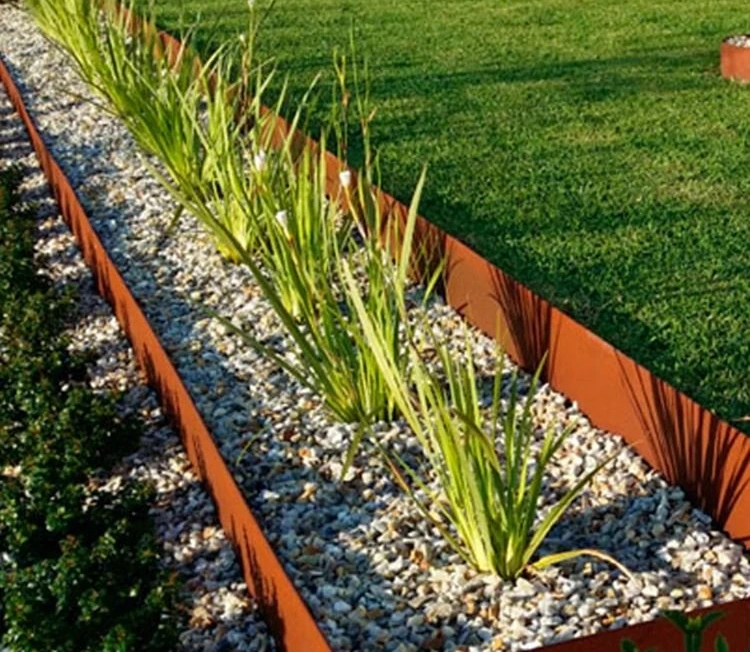
Australia’s coastline stretches over 25,000 kilometres, with a significant portion of commercial and residential developments concentrated within 50 km of the shore. For landscape architects and specifiers working in these salt-laden environments, selecting the right steel edging material is not a matter of aesthetics alone — it’s a long-term durability decision that affects maintenance budgets for decades.
Corten steel (ASTM A588 / A242 equivalent, known locally in Australia under AS/NZS 3678 Grade 350 weathering steel designations) has become the preferred material for landscape edging in coastal zones from the Gold Coast to Perth’s western suburbs. This guide provides the technical data, installation specifications, and project evidence you need to confidently specify corten edging for Australian coastal applications.
Why Corten Steel Outperforms Other Edging Materials in Coastal Australia
The Australian coastal environment presents a unique combination of challenges: high UV exposure (UV Index regularly exceeds 11 in summer), salt spray concentration from prevailing onshore winds, cyclonic rain events in northern regions, and sandy soils with variable pH levels. Standard mild steel edging corrodes rapidly in these conditions, often showing structural degradation within 3-5 years even with galvanised or powder-coated finishes.
Corten steel’s protective patina layer (composed of stable iron oxyhydroxide compounds) forms specifically in response to wet-dry cycling — a pattern that occurs daily in coastal Australia due to dew formation, sea mist, and afternoon sea breezes. The patina reaches functional stability within 18-36 months in most Australian coastal locations, compared to 24-48 months in cooler European climates.
Corrosion Rate Data: Coastal vs Inland
Published testing from the Australasian Corrosion Association (ACA) shows the following corrosion rates for weathering steel in Australian environments:
| Environment Classification (AS 4312) | Typical Location | Corrosion Rate (µm/year) | Expected Service Life (3mm edging) |
|---|---|---|---|
| C3 – Medium | Urban inland (Sydney western suburbs) | 25-50 | 60+ years |
| C4 – High | Coastal suburban (1-5 km from shore) | 50-80 | 35-50 years |
| C5 – Very High | Coastal exposed (< 1 km from shore) | 80-150 | 20-35 years |
| CX – Extreme | Direct splash zone / tropical coast | 150-250 | 12-20 years |
For landscape edging applications, a minimum thickness of 3mm is standard for residential projects, while 4-6mm is recommended for commercial and municipal installations in C5/CX zones. At these thicknesses, corten edging provides a practical maintenance-free service life of 25-40 years in most coastal locations — far exceeding powder-coated mild steel (5-10 years before recoating) or aluminium edging (prone to galvanic corrosion when in contact with soil minerals).
Australian Standards and Compliance Requirements
When specifying corten edging for council or government projects in Australia, the following standards and requirements apply:
Material Standards
AS/NZS 3678 Grade 350 is the local equivalent for structural weathering steel plate. For edging profiles formed from strip or coil, AS/NZS 1594 HW350 applies. Both provide the copper, chromium, nickel and phosphorus alloying that enables the protective patina formation.
Key composition requirements under AS/NZS 3678 Grade 350 weathering:
- Carbon: 0.12% max
- Copper: 0.25-0.55%
- Chromium: 0.40-0.70%
- Nickel: 0.12-0.40%
- Phosphorus: 0.07-0.15%
- Yield strength: 350 MPa minimum
Environmental and Planning Considerations
Several Australian councils have specific requirements regarding corten steel runoff. The orange-brown patina produces iron oxide-rich water during the initial weathering phase (first 12-18 months), which can stain adjacent concrete, pavers, and light-coloured stone.
Councils with documented runoff management requirements include:
- City of Sydney: Requires drainage management plan for corten elements above hardscaped areas
- Gold Coast City Council: Accepts corten in landscape plans but requires stormwater protection during patina formation
- City of Melbourne: Active specification of corten in public realm projects (Southbank Boulevard, Royal Botanic Gardens edge treatments)
- City of Perth: Used extensively in Elizabeth Quay and Yagan Square landscape detailing
Profile Options and Dimensions for Coastal Edging
Corten landscape edging for Australian coastal projects is typically available in the following standard profiles:
Flat Strip Edging
| Dimension | Residential Spec | Commercial Spec | Heavy-Duty Municipal |
|---|---|---|---|
| Height (visible) | 100-150mm | 150-200mm | 200-300mm |
| Below-ground depth | 75-100mm | 100-150mm | 150-200mm |
| Thickness | 3mm | 4mm | 5-6mm |
| Standard lengths | 2400mm | 2400-3000mm | 3000-6000mm |
| Weight per lineal metre | 2.4-3.5 kg/m | 4.7-6.3 kg/m | 7.8-14.1 kg/m |
L-Profile and U-Channel Edging
For areas with high foot traffic or where mowing equipment regularly contacts the edging, L-profile (with a 30-50mm horizontal base foot) provides significantly improved stability. The base foot is buried below soil level and anchored with steel pegs at 600mm centres.
U-channel profiles are primarily specified for raised path edging where a clean top edge is required and the channel captures both the path surface material and the adjacent garden bed soil.
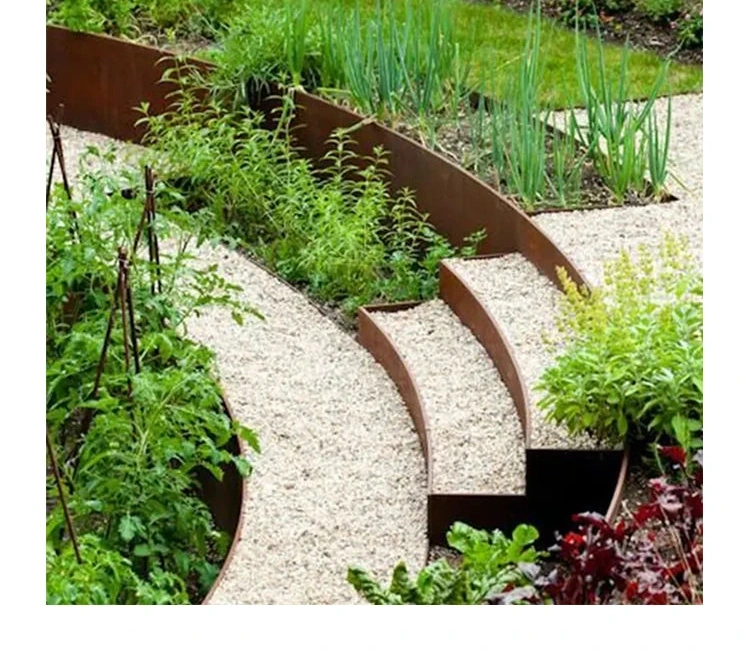
Curved and Radius Sections
Corten edging can be factory-rolled to specific radii for curved garden beds and pathways. Minimum bend radius depends on thickness:
- 3mm material: minimum 300mm internal radius
- 4mm material: minimum 500mm internal radius
- 5mm material: minimum 800mm internal radius
- 6mm material: minimum 1000mm internal radius
For tighter curves, segmented construction with butt-welded joints at 150-200mm intervals is standard practice. All welds must be ground flush and treated with a phosphoric acid wash to accelerate uniform patina formation across the weld zone.
Installation Specifications for Australian Coastal Conditions
Subgrade Preparation
Sandy coastal soils present unique challenges for edging installation. The key issue is lateral movement — without adequate ground preparation, sandy soils allow the edging to shift over time due to wind vibration, root pressure, and water movement.
Recommended subgrade preparation for coastal sand:
- Excavate trench to 250mm depth minimum (for 150mm visible edging height)
- Compact trench base using a plate compactor — target 95% Standard Proctor density
- Install 75mm compacted road base (FCR or recycled crushed concrete) as foundation layer
- Set edging to line and level on compacted base
- Drive galvanised steel stakes (not mild steel — galvanic protection needed) at 800mm maximum centres
- Backfill both sides with compacted material, not loose sand
Connection and Jointing Details
For coastal installations, connection methods must account for thermal expansion. Corten steel has a coefficient of thermal expansion of approximately 12 × 10⁻⁶ /°C. A 3-metre length in a location with a 40°C annual temperature range (e.g., Perth, where winter lows reach 5°C and summer extremes exceed 45°C) will expand/contract by approximately 1.4mm.
Recommended jointing methods:
- Slip joints: 50mm overlap with a single fixing allowing longitudinal movement — preferred for straight runs over 10m
- Butt joints with backing plate: 2mm gap between sections, bridged by a 100mm backing plate fixed to one section only
- Welded joints: Suitable for fixed geometry (circles, tight curves) where the entire assembly can move as a unit
Fixing to Concrete or Masonry
Where corten edging meets concrete paths, retaining walls, or building foundations, use stainless steel (Grade 316 for coastal) mechanical fixings. The galvanic potential between corten and stainless is minimal (both are passive in coastal atmospheres), making this the preferred combination.
Avoid using zinc-plated fixings in direct contact with corten — the zinc sacrificially corrodes at an accelerated rate, leading to premature fixing failure. Hot-dip galvanised fixings are acceptable where embedded in concrete but should not be exposed to the weathering atmosphere in direct corten contact.
Climate Zone Considerations Across Australia
Tropical North (Cairns, Darwin, Broome)
High humidity (average 70-80% RH) and monsoon rainfall accelerate initial patina formation but can also create conditions for non-protective corrosion if the steel remains constantly wet without drying cycles. Key specifications for tropical coastal zones:
- Minimum 5mm thickness recommended
- Ensure free drainage — do not allow soil to bank against both sides creating a moisture trap
- Minimum 50mm clearance between soil surface and top of edging for air circulation
- Consider protective coating for below-ground portion (coal tar epoxy or similar) to reduce sub-surface corrosion rate
Temperate Southeast (Sydney, Melbourne, Adelaide)
Ideal conditions for corten patina development. The regular wet-dry cycling from sea breezes, moderate humidity (50-65% RH average), and warm temperatures promote stable patina within 18-24 months. Standard 3-4mm thickness is suitable for most applications within 2-5 km of the coast.
Arid West (Perth, Fremantle, Geraldton)
Western Australia’s dry coastal climate (average RH 40-55%) slows patina formation. Edging in Perth’s coastal suburbs typically requires 24-36 months to achieve full patina stability. However, the lower moisture environment results in slower corrosion rates once stable, potentially extending service life by 20-30% compared to eastern coastal equivalents.
Special consideration: Perth’s alkaline sandy soils (pH 8-9 in many coastal areas) can affect below-ground corrosion patterns. A bituminous coating on buried sections is recommended where soil pH exceeds 8.5.
Southern Cool Climate (Hobart, Coastal Victoria)
Cooler temperatures (mean annual 12-14°C) slow the electrochemical patina formation process. Allow 30-48 months for full stabilisation. Frost cycles do not damage the patina but can cause minor spalling of loose oxide layers during early formation — this is normal and self-healing.
Cost Analysis: Corten vs Alternatives for Coastal Projects
The following cost comparison uses 2024/2025 Australian market pricing (AUD, ex-GST) for a hypothetical 200-lineal-metre commercial edging installation in a C4-C5 coastal environment:
| Material | Supply ($/m) | Install ($/m) | 10-Year Maintenance | 25-Year Total LCC ($/m) |
|---|---|---|---|---|
| Corten steel 4mm | $85-120 | $45-65 | Nil | $130-185 |
| Galvanised steel 3mm | $45-65 | $40-55 | Repaint every 7-10 years ($35/m per cycle) | $190-260 |
| Powder-coated aluminium | $95-140 | $50-70 | Recoat every 10-12 years ($45/m per cycle) | $235-320 |
| Concrete mow strip | $60-90 | $80-120 | Crack repair/replacement at 15 years ($70/m) | $210-280 |
| Natural stone edging | $150-250 | $100-150 | Repointing every 10 years ($25/m per cycle) | $300-475 |
On a life-cycle cost basis, corten edging is the most economical choice for coastal projects with a design life exceeding 15 years. The initial supply cost premium over galvanised steel is recovered within 8-12 years through eliminated maintenance.
Case Studies: Corten Edging in Australian Coastal Projects
Barangaroo Reserve, Sydney NSW
One of Australia’s highest-profile waterfront landscape projects, Barangaroo Reserve features extensive use of weathering steel in its landscape detailing. The edging system uses 6mm corten plate, cut to 250mm visible height with 150mm buried depth. Installed in 2015, the edging shows consistent patina colouration and no measurable section loss after 10 years of direct harbour exposure.
The project specification required all steel to comply with AS/NZS 3678 Grade 350 WR (weather resistant), with mill certificates provided for each batch. Welded joints were ground flush and chemically treated to ensure uniform patina appearance.
Scarborough Beach Redevelopment, Perth WA
The Scarborough Beach foreshore project (completed 2018) uses corten edging throughout its coastal parkland areas. Exposed to direct Indian Ocean salt spray and Perth’s extreme summer temperatures (regularly exceeding 40°C), the 5mm edging sections have maintained structural integrity with the expected aesthetic patina development.
The specification included a requirement for 316 stainless steel stake fixings (rather than mild steel) due to the extreme corrosion environment classification (C5-CX at the beachfront interface).
South Bank Parklands Renewal, Brisbane QLD
Brisbane’s subtropical climate combined with proximity to the Brisbane River creates a high-humidity environment. The South Bank renewal project specified 4mm corten edging with an epoxy-coated below-ground section to manage the high moisture conditions in sub-tropical clay soils. Patina stabilised within 14 months due to the warm, humid conditions — faster than typical temperate installations.
Maintenance and Long-Term Performance
One of the primary advantages of corten edging in Australian coastal projects is the minimal maintenance requirement. However, “maintenance-free” does not mean “install and ignore.” The following periodic inspections are recommended:
Annual Inspection Checklist
- Alignment check: Verify edging remains at correct line and level — sandy soils can cause settlement
- Stake integrity: Check fixing stakes for looseness, particularly after significant storm events
- Soil level: Ensure soil has not accumulated above edging height on either side, which traps moisture
- Joint gaps: Verify expansion joints remain functional and have not been blocked by soil or debris
- Patina condition: Look for areas of active flaking or unusual orange/red powdery deposits (indicates non-protective corrosion, typically from persistent moisture exposure)
Addressing Common Issues
Uneven patina colour: Common in the first 12-24 months, particularly where sections have different orientations to prevailing weather. This self-corrects over time. Do not attempt to chemically “even out” the colour.
Staining of adjacent surfaces: Install a 50mm gravel strip between corten edging and concrete/paving to create a sacrificial staining zone. This gravel can be periodically replaced if aesthetics are a concern.
Impact damage: Dents from mowing equipment are cosmetic only and will patina over. Deep gouges exposing bright steel will re-patina within 6-12 months without intervention.
Root pressure displacement: Large tree roots can displace edging sections. The solution is root barriers (HDPE sheet installed vertically between tree and edging) rather than stronger edging fixings, which can cause the steel to deform.
Specification Template for Australian Coastal Projects
The following specification clause can be adapted for use in Australian landscape architectural documentation:
LANDSCAPE EDGING — WEATHERING STEEL
Material: Weathering steel to AS/NZS 3678 Grade 350 (or AS/NZS 1594 HW350 for strip/coil product). Minimum yield strength 350 MPa. Chemical composition to include copper (0.25-0.55%), chromium (0.40-0.70%), and nickel (0.12-0.40%) as specified in the standard.
Thickness: [Insert based on environment classification — minimum 3mm for C3-C4, minimum 4mm for C5, minimum 5mm for CX per AS 4312]
Profile: [Insert — flat strip / L-profile / U-channel / custom]. Visible height [X]mm, buried depth minimum [Y]mm.
Finish: Mill scale removed by mechanical abrasion (SA 2 minimum) prior to delivery. No protective coating to be applied to exposed surfaces. Below-ground surfaces to receive [coal tar epoxy / bituminous coating / none] as specified.
Fixings: Stainless steel Grade 316 stakes at maximum 800mm centres, minimum 400mm driven depth. Connection hardware to be Grade 316 stainless steel throughout.
Joints: [Slip joint with 50mm overlap / butt joint with backing plate / welded — select appropriate]. Minimum 2mm expansion gap at butt joints.
Certification: Supplier to provide mill certificates confirming chemical composition and mechanical properties for each heat/batch of steel supplied.
Sourcing Corten Edging for Australian Projects
When sourcing corten landscape edging for Australian coastal projects, consider the following factors:
Import vs Local Fabrication
Australia has limited domestic weathering steel plate production. Most corten raw material is imported (primarily from Japan, Korea, and China), with local fabrication into edging profiles. This two-step supply chain means lead times of 8-12 weeks for standard profiles and 12-16 weeks for custom sections.
Direct-from-factory imports (such as from Corten Factory’s landscape edging range) can reduce costs by 20-35% compared to local fabrication from imported plate, particularly for projects requiring over 100 lineal metres. Factory-direct supply also ensures consistent quality control across the full production batch.
Quality Verification
Critical checks when receiving imported corten edging:
- Request mill test certificates (MTC) for every shipment — verify Cu, Cr, Ni, P content meets AS/NZS 3678 Grade 350 equivalent composition
- Conduct visual inspection for mill scale condition — heavy, tight mill scale slows patina formation
- Check dimensional tolerances — ±1mm on height, ±0.5mm on thickness for commercial grade
- Verify weld quality on fabricated joints — no porosity, undercutting, or incomplete fusion
For projects using corten steel products from established manufacturers, mill certificates and quality documentation should be provided as standard. Request these at quotation stage and include the requirement in purchase orders.
Design Integration: Combining Edging with Other Corten Elements
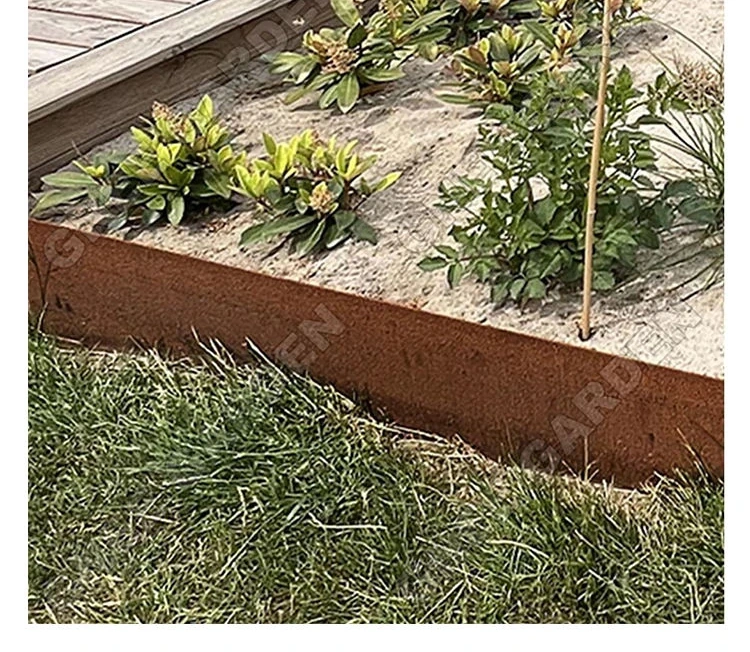
Corten edging achieves its greatest visual impact when integrated with other weathering steel landscape elements. The consistent patina colour across different element types creates a unified material language throughout the project.
Common combinations for Australian coastal projects:
- Edging + corten planters: Raised planter boxes with matching ground-level edging defining adjacent garden beds
- Edging + retaining walls: Low corten retaining walls (300-600mm) transitioning to flush edging on level areas
- Edging + water features: Corten edging channeling towards a weathering steel water blade or rill
- Edging + screening: Consistent material from ground plane (edging) to vertical plane (privacy screens or windbreaks)
When specifying multiple corten elements from different suppliers, ensure all materials share compatible composition specifications. Different alloy compositions can result in noticeably different patina colours — a common issue when mixing Chinese and Japanese-origin materials.
Environmental and Sustainability Considerations
For projects pursuing Green Star or ISCA ratings in Australia, corten steel edging offers several sustainability advantages:
- Longevity: 30-50+ year service life reduces replacement frequency and associated carbon emissions
- No coatings: Eliminates VOC emissions from painting and the environmental impact of coating manufacture and disposal
- Recyclability: 100% recyclable at end of life — weathering steel is readily accepted by scrap processors
- Recycled content: Many EAF (electric arc furnace) produced weathering steel products contain 80-95% recycled content
- No maintenance chemicals: No rust inhibitors, paint strippers, or cleaning chemicals required over the product lifetime
Under the Green Star Materials credit framework, corten edging can contribute points for durability (reduced maintenance), recycled content, and low-toxicity materials. Obtain Environmental Product Declarations (EPDs) from the manufacturer where available to support Green Star submissions.
Conclusion and Specification Summary
Corten steel landscape edging is the technically superior choice for Australian coastal projects where long-term performance, minimal maintenance, and design quality are priorities. The material’s natural response to coastal atmospheric conditions — forming a stable, self-healing protective layer — aligns perfectly with the environmental demands of Australia’s shoreline developments.
For landscape architects and specifiers working on coastal projects, the key decisions are:
- Determine AS 4312 corrosivity category for your site location
- Select appropriate thickness (3-6mm based on exposure severity)
- Specify AS/NZS 3678 Grade 350 or equivalent weathering steel composition
- Detail connections using Grade 316 stainless steel hardware
- Include drainage management for the initial patina formation period
- Specify quality documentation requirements (mill certificates, dimensional inspection)
With proper specification and installation, corten edging will deliver maintenance-free performance for 25-40 years in most Australian coastal environments — a period that outlasts virtually every alternative material on a life-cycle cost basis.
For project-specific quotations and technical support on corten landscape edging, view the full range of corten edging profiles available for Australian delivery, or contact the technical team for custom profile development to suit your project requirements.
Frequently Asked Questions: Corten Edging in Australian Coastal Zones
Does corten steel edging stain surrounding surfaces?
During the first 12-24 months of patina formation, iron oxide particles wash off the surface during rain events. This creates orange-brown staining on adjacent concrete, light-coloured pavers, and natural stone. The solution is to either install a 50-75mm gravel buffer strip between the edging and any light-coloured paving, or to accept that some staining will occur and clean periodically with oxalic acid solution (available from hardware stores as “rust remover” or “timber deck cleaner”). Once the patina stabilises, staining effectively ceases.
Can corten edging be installed directly in beach sand?
Direct installation in unconsolidated beach sand is not recommended without subgrade improvement. Sand particles do not provide lateral support, and wind and water action will undermine the edging within months. At minimum, install a compacted road base (crushed rock) foundation beneath and on either side of the edging to a depth of 75mm. For foreshore applications, consider pinning the edging to a concrete strip footing concealed below the sand surface.
What is the minimum distance from the ocean for corten to perform well?
Corten steel performs acceptably in all Australian coastal environments, but the service life and thickness requirements change with proximity. Within 100 metres of the high-water mark (direct salt spray zone, classified CX under AS 4312), specify minimum 5-6mm thickness and accept a 15-20 year replacement cycle. Between 100m and 1km (C5 classification), 4-5mm provides 25-35 years of service. Beyond 1km from shore (C4), standard 3-4mm edging will last 35-50 years with no maintenance.
How does cyclone-rated wind affect corten edging?
In northern Australian cyclone zones (wind region C and D under AS/NZS 1170.2), landscape edging is not typically subject to wind loading analysis as it presents minimal wind sail area. However, wind-driven sand abrasion can accelerate surface wear on the windward face. For cyclone-prone coastal areas, increase specified thickness by 1mm above the corrosion-only requirement to account for abrasion losses over the design life.
For related sourcing details, compare corten edging, screens, facade panels, Corten Steel Water Features for UK Public, and Corten Steel vs Mild Steel: Outdoor Project before finalizing requirements.
Need a factory quote for Corten Steel Landscape Edging for Australian Coastal Projects: Complete Specification Guide?
Send your drawings, size list, quantity and destination country. Corten Factory can support custom weathering steel fabrication, export packing and project quotation.